Update: Farmer One was purchased by StoryFront, and is now exclusively available on Kindle.
My newest book/novella, Farmer One, is now available in all formats (Kindle, Nook, iBooks, EPUB, and HTML). If you’ve read my other work, you’ll find that this one is a little different. It’s still science fiction, but I took it in a slightly new direction. Here’s the synopsis:
In an economically depressed and politically dysfunctional United States, the long-defunct National Aeronautics and Space Administration is reestablished in a desperate attempt to channel the patriotism and optimism of the previous century’s Soviet Space Race. But this time, the nation to beat is China, and the goal is Mars.
Far behind steady advances in Chinese aerospace engineering and even lunar colonization, a team of American scientists, engineers, and astronauts struggles to integrate decades-old technologies, untested prototypes, and some very out-of-the-box thinking to give their nation a shot at one of the most important achievements in human history. Nothing goes as planned while pursuing what appears to be the impossible, but the ultimate surprise lies in the mission’s conclusion.
This quirky and intelligent novella by Christian Cantrell is both humorous and unpredictable as it explores an unfamiliar, but not entirely unimaginable, post-superpower United States.
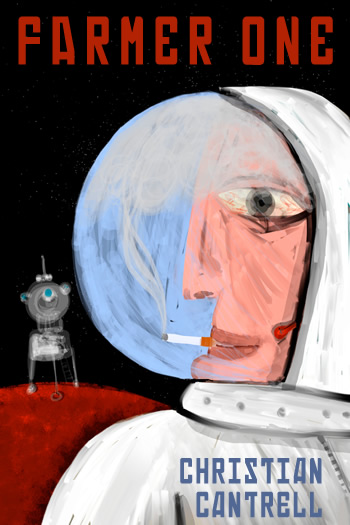
I owe special thanks to David Coletta and Ben Rossi for their excellent editorial assistance.
 Whenever cloud services like EC2 or Google Docs experience downtime, there are always plenty of comments about the dangers of relying on the cloud. While it’s true that depending on third parties (both your ISP and the provider of the cloud service itself) for basic computing tasks like document editing can be risky, it’s also important to look at and understand the entire equation before evaluating cloud services. Here are some things to consider:
 Living Digitally