The Ultimate Irony of Climate Change: Before We Created It, It Created Us

human_brain_size

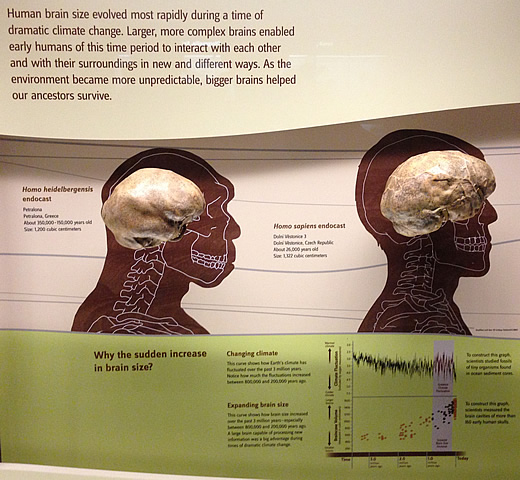
The picture above was taken at one of the best exhibits I’ve ever seen in any museum: the Hall of Human Origins at the Smithsonian National Museum of Natural History. The chart in the lower right-hand corner shows the correlation between brain size in humans and drastic changes in climate with an emphasis on the period between 800,000 and 200,000 years ago. (A nicer version of this chart is available on the exhibit’s website.)

It makes perfect sense that greater intelligence (as evidenced by larger brains) proved advantageous during times of unpredictable weather since the more humans were able to plan ahead, communicate, and work collaboratively, the more likely they were to survive. In fact, I’ve even read that the cranial capacity of fossilized skulls gets larger the further away from the equator they occurred, suggesting a correlation between larger brains and harsher weather. In other words, in terms of natural selection, everything here appears to be in perfect working order.

But while there are no surprises in the relationship between brain size and climate change, there certainly is plenty of irony. The eventual result of all of that hard-fought intelligence were both the agricultural and industrial revolutions — precisely the technological advances that are most closely associated with modern climate change. Therefore, one could theorize that surviving rapid climate change bestowed upon humanity just enough intelligence to create even more rapid and dangerous climate change. One might even go so far as to say that the human brain is attempting to self-perpetuate continued growth.

I’ve read conflicting predictions of how this latest wave of climate change will ultimately affect brains size. Since equatorial temperatures will continue to expand latitudinally, it’s possible that the human brain could suddenly stop growing; on the other hand, due to all the challenges humanity faces as a result of rapid climate change, the size of our brains could continue to grow — perhaps at an even faster pace. Personally, I’m hoping for a future where we learn to use technology, intelligence, and even a little empathy to finally take control of our own evolutionary paths. Although it’s a little late for me to be genetically engineered, I wouldn’t mind a few multi-core petaflop processors embedded in my brain and at least one robotic arm.

The Miniaturization of Warfare

wmd_world_map

Growing up in the 80s, we were taught to fear a nuclear attack by the Soviet Union. Today, I think it’s fair to say that most people believe cyberwarfare is probably a greater threat than a full-scale nuclear holocaust.

What many people don’t fully grasp about nuclear weapons (in particular, those who object to reducing our stockpiles) is that they constitute a tremendous expense without all that much benefit — primarily due to the fact that governments can’t actually use them. Whereas the U.S. currently deploys conventional weapons on a weekly and sometimes daily basis, it’s very difficult to imagine a scenario where the United States could justify launching a nuclear attack of even the smallest scale.

This concept is critical to the plot of my story The Epoch Index, and is probably best described by the following passage:

After centuries-old rivalries finally escalated into full-scale nuclear conflicts, the United Nations drafted and unanimously voted into effect a resolution unequivocally banning any sized nuclear arsenal anywhere on the planet. The U.S. and other early nuclear adopters were happy to back (and help enforce) the new international law, having long ago anticipated the nuclear backlash and invested heavily in Prompt Global Strike systems: networks of launch vehicles and hypersonic cruise missiles designed to deliver warheads filled with scored tungsten rods twice as strong as steel and capable of ripping any structure anywhere on Earth to shreds in less time than it takes to have a pizza delivered. Thermonuclear hydrogen bombs were old news, as far as most world powers were concerned. The only reason to unleash 50 megatons of destruction is if you have very little faith in the accuracy of your delivery mechanisms. Modern weaponry can target down to the square centimeter, and since it uses real time topographical guidance, it can do so even when your entire GPS satellite network is compromised. Besides, what’s the point of defeating another nation if your great grandchildren can’t even set foot in it, and just about everything worth looting, pillaging, or oppressing is either incinerated or radioactive? Nuclear weapons are clumsy and inelegant. High-tech conventional is the new thermonuclear. Modern militaries say less is more.

In my upcoming novel Kingmaker, drones are a central theme:

It wasn’t special operations teams that concerned him; he was confident he could see a takedown coming in plenty of time, and even if he didn’t, he probably stood as good a chance of walking away from a team of Navy Seals as any one of the Seals themselves. What Alexei feared was death from above. With a well coordinated drone strike, you were simply there one moment, and everywhere but there the next. It didn’t matter how quick you were, or how smart, or how well trained. If you were on the CIA’s radar, they knew how to get you off of it and still be home in time for dinner and to kiss the kids goodnight. All it cost them was barely an hour’s worth of classified paperwork that everyone already knew would never see the inside of either a civilian or military courtroom.

As a deterrent, maintaining a nuclear arsenal equal to (or slightly greater than) those of one’s rivals still makes some strategic sense, however the reality is that weapons which can be relatively inexpensively and surreptitiously deployed are far more menacing than weapons that everyone knows you cannot actually use. In other words, the world has much more to fear from weapons that can — without due process — target buildings, vehicles, and even individuals than indiscriminate warheads that can destroy entire cities.

Just as in the world of technology, we are now witnessing the miniaturization of warfare.