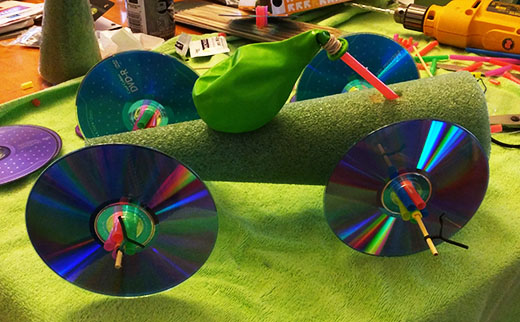
First, we did the classic egg drop project. Then we created our own private phone line. And now for our most recent elementary school project: an air-powered balloon car.
The rules were as follows:
- The car had to be 100% air-powered.
- It could compete in the categories of speed, distance, or just aesthetics. (We went for distance.)
- The vehicle had to use wheels, and the wheels had to be made out of objects that were not intended to be wheels. (My daughter instantly decided we were going to use CDs—a curious and quaint technology to today’s 5th-grader.)
This is how we built it:
- The body is conical floral foam from a craft store.
- The axles are wooden skewers from the grocery store.
- The wheel bearings are six straws shoved through the hole in the CD—five around the parameter, and one through the center.
- Plastic twist ties ensure the wheels don’t come off.
- Thrust is provided by a balloon attached to a straw, then threaded through a hole I drilled in the body.
So how did it do? Unfortunately, we didn’t win. The car performs really well on the right surface (once it gets going, it coasts a very long way), but if the surface isn’t right, or if you don’t have enough room (it has a tendency to curve), performance suffers. Here are a few lessons we learned that you might want to take into consideration if building your own air-powered car:
- I found it really difficult to get the axles straight. The foam wanted to guide the skewers off-center as I pushed them through, and any misalignment costs you dearly both in friction and in the car’s ability to hold a straight line.
- If I were starting over, I’d try to find plastic axles rather than wooden. Cheap wooden skewers splinter easily and generate much more friction than a smooth plastic surface would.
- The CDs were really difficult to work with. My daughter was insistent that we use CDs as wheels (actually, these are DVD-Rs), but they tend to dig into soft surfaces and slip on hard surfaces that are too smooth. You might consider wheels that are a little broader so that they have larger contact patches. (The wheels are the one place you want a little friction.)
- If you really want to win, find the most minimalistic body you possibly can (toilet paper tube, for instance), some extremely light and basic wheels (foam balls, perhaps, since they’re grippy and should provide excellent contact on any surface), and just tape the biggest balloon to it that you possibly can. If it only has to last a single race (plus a few trials), building something elegant and robust will cost you dearly in weight. Keep is simple, minimal, and most important of all, lightweight.
But if you want to build something that I think strikes a good balance between robustness, elegance, and performance—something that teaches the basic principles of Newtonian physics—this guide is a good place to start.

 Not being much of a tablet fan, I prefer to sit at the kitchen table or on the couch with a laptop. But both of my laptops—a 15″ MacBook Pro, and a 2015 Razer Blade—are so thoroughly connected to peripherals at this point (external monitors, speakers, USB audio interfaces, mechanical keyboards, an Oculus Rift, etc.) that I find I often don’t feel like going through the trouble of liberating them. But that wasn’t always the case. Before I got the Razer Blade, my personal machine was a MacBook Air, and I made it a point to almost never connect it to anything so that it was always ready to be taken anywhere I needed it.
 Living Digitally