Artificial Photosynthesis Becomes Reality (as Predicted in “Containment”)

My science fiction record is getting better. Last week, scientists theorized that it might be possible to use the LHC as a time machine (which is the premise of my story The Epoch Index), and this week, artificial photosynthesis, one of the themes of my novel Containment, becomes a reality.

Check out the article on the ACS website for more details, but the general idea is that Dr. Daniel Nocera, a scientist at MIT, says his team has successfully developed the first practical artificial leaf. In his own words:

A practical artificial leaf has been one of the Holy Grails of science for decades. We believe we have done it. The artificial leaf shows particular promise as an inexpensive source of electricity for homes of the poor in developing countries. Our goal is to make each home its own power station. One can envision villages in India and Africa not long from now purchasing an affordable basic power system based on this technology.

In Containment, the concept is called AP, or artificial photosyntheses, since the scientists are not so much interested in creating an artificial leaf as mimicking (and improving on) the chemical processes that happen inside the leaf. Interestingly, the scientists’ objective in Containment isn’t the energy that photosynthesis creates, but the oxygen byproduct.

Here’s a quote from one of the lead scientists studying the problem from Ishtar Terra Station One, humankind’s first permanent outpost on Venus:

The Agriculture Department has perfected stemstock, or meat without the animal, and now we need to perfect photosynthesis without the plant. As much as I love our ferns, the day is coming when we’re going to need more oxygen than they are able to provide us. Without more oxygen, V1 is as big as it’s ever going to get, and it will always be vulnerable to things like pathogens and any number of other events that can unexpectedly destroy plant life.

If this is the kind of thing you’re into, give Containment a try. It’s available in all digital formats, and for this much hardcore science fiction, you can’t beat the price.
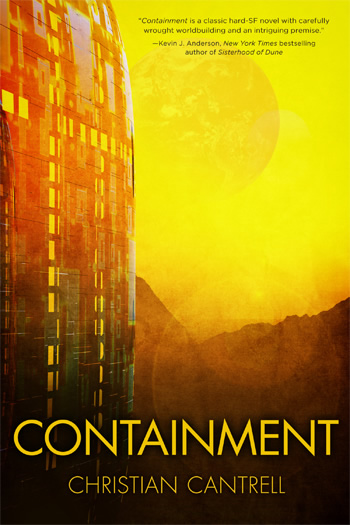
containment_350x525

Introducing “Venom”

My newest story/novella, Venom, is now available in all formats (Kindle, iBooks, Nook, EPUB, and HTML). Maybe it’s just because Venom is the most recent thing I’ve written, but I feel like it’s one of my favorites.

Venom is sort of a parallel story to Human Legacy Project. It takes place in the Human Legacy Project universe, but it’s an entirely independent story describing the rise of the People’s Party, and the HLP’s attempts to infiltrate it.

If you like fiction — especially science fiction — give Venom a try. For this much hard-core sci-fi, you can’t beat the price.

venom_350x525

Review of the BUILT Kindle Sleeve

built_kindle_caseI was a big fan of Amazon’s Lighted Leather Kindle Cover, but whenever I took my Kindle out of the case, I was always amazed by how light the device is, and how much weight the lighted case adds to it. One of the advantages of reading on a Kindle (as opposed to a tablet) is that the Kindle is far lighter than either my Xoom or my iPad. So I finally decided to ditch the cover and go with a sleeve, instead.

I’ve had dozens of neoprene gadget cases in the past, so I decided to try the BUILT Neoprene Kindle Sleeve. It’s extremely lightweight, very well cushioned, and shaped perfectly. Now my Kindle is well protected when I’m not using it (I’ve already dropped it while in the case on a hardwood floor, and it was perfectly fine), but I can pull it out and enjoy the lightness and form-factor of the Kindle the way it is was designed to be enjoyed.

The only problem is that the case is a little pricey. At $29.99, I was hesitant, but although I would have liked a cheaper alternative, I’ve been very happy with it.

Tropicana Needs Branding Help (Again)

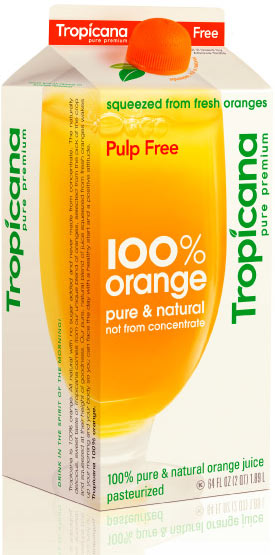
I think it’s time for Tropicana to find a new marketing and branding firm. First, they went after the generic orange juice market with this:

tropicana_art_fail_1

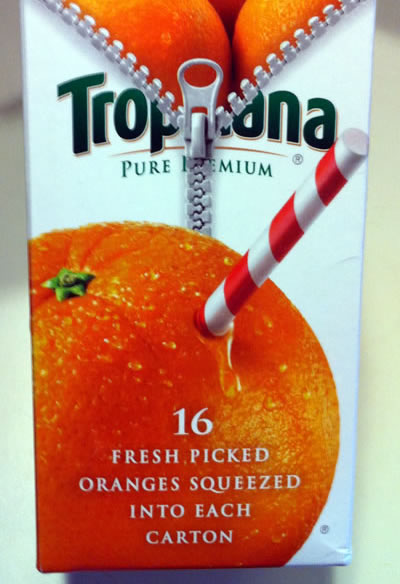
And now they’re apparently chasing the young male demographic with this:

tropicana_art_fail_2

Tropicana, I think your focus groups are messing with you.

My Science Fiction May Become Fact: The LHC and Time Travel

lhcMy friend PolyGeek forwarded a story to me this morning that completely caught me off guard. The article is called Atom Smasher Could Be Used As Time Machine, and it describes a proposal put forth earlier this month by two physicists that the Large Hadron Collider could be used to send particles — and hence message — forward and backward in time.

Other than being incredibly cool, why was I so intrigued? This is precisely the premise of a story I published in August of last year called The Epoch Index.

An excerpt from the article:

The scientists outline a way to use the Large Hadron Collider (LHC), a 17-mile long (27-km) particle accelerator buried underground near Geneva, to send a hypothetical particle called the Higgs singlet to the past.

And an excerpt from The Epoch Index:

But the LHC ended up finding something which most people consider to be far more interesting. As the data analysis algorithms parsed through the petabytes of recorded data, they began to uncover very regular patterns in the spins of newly discovered particles. While the direction of the particles’ spins initially appeared random, the analysis began detecting a repetition which looked increasingly like sequences of bytes, and which were eventually decoded into various forms of digital data: text, images, audio, and even simple video. When it was determined beyond a doubt that the encoded information referenced people, events, and dates that did not yet exist, the site was immediately secured and the project promptly put under the control of a small team from the UN. The name of the mysterious particles whose spins had turned out to be tiny windows into the future was changed from “saxions” to “tachyons” — a term derived from the greek word takhus meaning “swift.” The LHC had proven for the first time and beyond any doubt that it was possible for matter to travel faster than the speed of light. At least at the particle level, time travel was possible.

I’ll let them take the Nobel Prize for physics as long as I get the one for literature.

Free Advice: Amazon Should Partner with Printer Manufacturers for One-touch Ordering of Ink Cartridges

First of all, I should make it clear that I hate just about all printers on the planet. Most are poorly manufactured, the drivers are buggy, and they end up being money pits (as they were intentionally designed, no doubt). But here’s a way that owning one of these pieces of clunky and largely obsolete technology could be slightly less horrible:

When you set up your printer, you should be prompted to optionally enter your Amazon credentials. If I choose to provide them, when I start to get low on ink, I should be able to order the correct cartridges with the press of a button, and have them arrive at my door within two days. The advantages of such a partnership are probably pretty obvious, but I’ll spell them out anyway:

  1. Printer manufacturers: you will sell more ink at a faster rate. When I currently start to run out of ink, I put off the purchase of new cartridges for as long as possible. Not only is it inconvenient to have to go out to the store, but looking through a book or searching online for the right package of ink is just not how humanity should be spending its time in the year 2011.
  2. Amazon: you can probably put the final nail in the coffin of Office Depot and Staples. Could these companies still exist if they lost 80% of their printer cartridge sales? What else do people buy there?
  3. Customers: Owning and operating a printer would suck just a little less. Although ink is still way overpriced, and printers are almost as big of a racket as cable TV and mobile phone plans, at least getting ripped off would be considerably more convenient.

Of course, Amazon isn’t the only option here. Staples and Office Depot could try to negotiate such agreements, as well, or the printer manufacturers could try to sell directly to consumers and cut retailers out entirely. However, because of Amazon’s brand recognition, generally good reputation with consumers, and extremely robust retail infrastructure, I think they are best positioned to pull something like this off.

PS: If you love printers as much as I do, you might enjoy The Oatmeal’s Why I Believe Printers Were Sent From Hell.

Free Advice: Apple Should Start Manufacturing in the US

Here’s some free advice for Apple and other technology companies: start moving some of your manufacturing to the US. Buy up some plants and factories in places like Detroit, and start using them to manufacture things like iPhones, iPads, touch screens, memory chips, CPUs, and laptops.

I know it would be expensive, and I know they would lose money — at least initially. But here are the advantages:

  • First and foremost, Americans need jobs. Although we are technically largely out of the latest recession, the economic reality is that there are still way too many unemployed Americans (and things are likely to get worse with so much uncertainty in the Middle East and Japan). On the one hand, devices like the Kinect are setting world records for sales and there are huge lines for the iPad 2, but on the other hand, the unemployment rate is still far higher than it should be. Why not put Americans to work building the same devices we stand in line for?
  • Manufacturing needs to return to the US at some point — why not now? I’m convinced that the day will come when the US will be forced to start doing more manufacturing on its own soil. Yes, the economy has become truly global, but that doesn’t mean competition between countries goes away. I believe there are advantages to a nation being able to manufacture the products its citizens rely on.
  • Imagine the goodwill. We all know that Apple makes great devices, but imagine the goodwill and press that Apple could get from selling great devices that are not only responsibly manufactured and responsibly recycled, but were also partially or entirely manufactured in the US. In addition to just "Designed by Apple in California," Apple could also boast "Made in America."
  • Apple could exert even more control over their products. Apple already controls a great deal of the life cycle of their products from the design all the way through the retail experience, but they don’t control the manufacturing process very well. Products are frequently leaked, and I know for a fact that components are sold on the black market (I’ve bought them in order to do at-home iPhone repairs). I suspect there is also a fair amount of IP that gets leaked when products and product designs are so far out of Apple’s control. By moving manufacturing to their own factories in the US, Apple could do a much better job of containing and controlling information, intellectual property, and even the hardware itself.

I’m not naive enough to think that this is a serious possibility since the return is probably too uncertain and too far off for a public company to take seriously. However, if Apple and other technology companies really want to change the world, there are more profound ways of doing it than just slick devices and marketing hype.