New Gaming PC

After relying primarily on consoles (Xbox and PS3) for gaming over the last few years (and occasionally a very nice Lenovo ThinkPad with a surprisingly capable graphics card), I decided it was finally time to build a serious gaming rig. I’m still tuning and tweaking, so I can’t give a final verdict yet, but so far, I’ve been very happy with it. Here are the components/specs:

  • Intel Core i7-2600K Sandy Bridge 3.4GHz CPU
  • 2x MSI N570GTX Twin Frozr II OC GeForce GTX 570 video cards
  • 16GB (4 x 4GB) Corsair Vengeance DDR3 240-Pin 1.5V SDRAM
  • 2x Western Digital 1TB 7200 RPM drives in a RAID 1 configuration
  • SAMSUNG 470 Series 128GB SATA II Internal Solid State Drive (so game data loads faster)
  • MSI P67A-GD53 ATX Intel Motherboard
  • LG Blu-ray/DVD/CD reader/writer
  • CORSAIR Hydro H70 CWCH70 CPU Cooler
  • CORSAIR 750W ATX12V power supply
  • COOLER MASTER Black Steel/Plastic ATX Full Tower Computer Case
  • Microsoft Windows 7 Professional

At this point, I’ve still put more time into building and tweaking than actual gaming, but hopefully that’s about to change. I’m a few hours into Fallout: New Vegas, and will probably go from there to Mass Effect, Brink, L4D, and eventually StarCraft II. Any other suggestions?

Update: I’ve gotten a lot of questions on cost, so here’s some additional information. I paid about $2,300 for everything (including Windows 7), shipped. If you’re interested in building your own gaming system, you can do it for much less, however. Here are some ways to save money without sacrificing very much (if anything) in the way of gaming performance:

  • Shop around rather than buying all your components from the same site. I spent enough time researching components that I didn’t want to spend even more time finding the lowest prices on them, so I was lazy and bought them all from the same retailer. That said, I bought them from Newegg which has pretty aggressive pricing, so I probably wouldn’t have saved very much.
  • Skip the liquid CPU cooler. The fan that comes with your CPU is sufficient. I just used a liquid cooling system for fun, and just in case I want to get really aggressive with the overclocking (which I haven’t yet).
  • Use fewer hard drives. I could have saved a lot of money just using a single 500GB drive rather than two 1TB drives and an SSD. In fact, this could probably have been my single biggest savings.
  • Buy a cheaper case. The case I decided on was expensive, but I wanted something nice and big for air flow and expansion, and I figured I’ll have the same case for a long time as I upgrade individual components. But there are much cheaper cases out there that will still work fine.
  • Buy less RAM. 8GM would have been plenty. 12GB is kind of ridiculous, but as you can see, I had a little too much fun designing this thing.

If I had really wanted to, I could have probably gotten the cost of everything down to about $1,800 and still had an amazing machine. Of course, I could have also spent much more, so I figure it all balances out in the end.

Two Things You Probably Didn’t Know About Garter Snakes

Update: The photograph below (taken by my daughter) is now part of the Wikipedia article on Garter snakes, and is the best picture of a posterior tooth I’ve seen.

Garter snakes are probably the best known species of snake in the US. They are easy to recognize, and they occur just about everywhere in North America. Most people will tell you that garter snakes are harmless, which they are, but probably not quite as harmless as you might think.

Garter Snakes Have Pretty Big Teeth

garter_snake_tooth

The picture above is of the snake I recently caught which taught me that garter snakes have relatively large teeth. Although he was very aggressive, I caught him without being bitten, however while holding him, he managed to get one of his teeth into my thumb (I would have been more careful if I’d known what he was packing). For a moment, I thought I’d misidentified him, but his markings couldn’t have been more clear. I used a small stick to (very gently) open his mouth, and sure enough, he had two needle-sharp teeth in there. While doing some research when I got home, I discovered another surprising fact:

Garter Snakes are Venomous

It was recently discovered that the saliva of a garter snake contains a very mild neurotoxin. Rather than injecting it through fangs, they spread it into wounds (presumably caused by those teeth) through a chewing motion. Although the venom of a garter snake is only potent enough to cause some minor swelling or itching in a human, it can stun a toad or small rodent enough to make swallowing it much easier.

Continue reading

An Audio Version of “Containment”

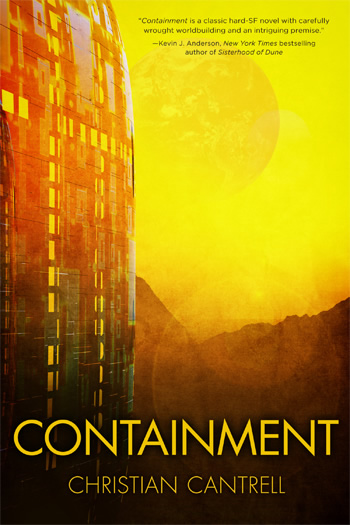
I’m very excited to announce that Containment will be an audio book published by Tantor Audio and available exactly one month from today (6/27/2011). It will be distributed through various vendors, including my favorite, Audible.com. Narrating will be William Dufris who has done everything from Isaac Asimov to Mark Twain (and was also the original voice of Bob the Builder in the US and Canada).

I’m a huge fan of audio books, and I always thought Containment would make a great production. I’m really looking forward to hearing it for the first time, and I hope some of you will check it out.

Snake Rescue

This is why it’s so important to clean up debris you find outside. This deer fencing probably blew out of someone’s yard in a storm and ended up in a creek by the Potomac. The garter snake inside was so ensnared that the fencing was cutting through his scales in several places.

garter_snake_in_deer_fencing

It took about 30 minutes to fully cut him out of the nylon mesh. We’re keeping him until his wounds heal since they may become infected.

rescued_snake

Where is Mobile Phone Privacy Headed?

There has been a lot of talk recently about privacy in the context of mobile phones, primarily thanks to the recent O’Reilly Radar article pointing out that some iOS devices store users’ location information. If you think this kind of thing is interesting and/or scary, I encourage you to read the Wall Street Journal article entitled The Really Smart Phone which argues that this is just the beginning of what mobile phones can and will track. In addition to several interesting experiments that are currently underway, the article points out situations where mobile sensor data is already being used/abused:

Cellphone providers are openly exploring other possibilities. By mining their calling records for social relationships among customers, several European telephone companies discovered that people were five times more likely to switch carriers if a friend had already switched… The companies now selectively target people for special advertising based on friendships with people who dropped the service.

I’ve spent a lot of time thinking about the direction this kind of technology could go in, and I’ve incorporated several of my ideas into two short stories: Human Legacy Project and Venom.

Both stories take place in a future United States (mostly) which has become increasingly totalitarian. The government gradually enacts legislation which gives them access to mobile phone and other sensor data which they use to track and control anyone they consider to be a dissident. Human Legacy Project tells the story of a non-profit organization dedicated to preserving the life stories of everyone on the planet, and how the group is transformed into a terrorist organization by the government’s ever-tightening grip. The two parties continue to feed off of each other until the conflict culminates in an event that nobody was prepared for.

Venom is a parallel story which describes how the controlling party gains and keeps power in what was once an open and democratic system. A young engineer figures out how to build a device which she believes will lead to the ultimate sustainable democracy, but when she discovers that her ideas have been used against her, she joins the HLP in an attempt to undo the damage her life’s work has inflicted on the entire nation.

I believe the number one job of science fiction is to entertain, however I also think that it can serve as both inspiration for the future, and a stern warning.

hlp_350x525

venom_350x525

Update (4/29/2011): Here’s another great example of sensor data being abused, this time by TomTom.

Update (5/11/2011): The government will require a special new chip in mobile phones.

Spring is Definitely Here

We took our first walk through the woods this year. Algonkian Park is one of our favorite spots, and it’s only about five minutes from the house. We caught a pretty big northern water snake, a wood frog, and we saw a very large fishing spider (which I did not attempt to catch).

northern_water_snake

Check out the photos on Flickr.

The Internet Didn’t Kill Newspapers; Newspapers Killed Newspapers

I know the conventional wisdom is that the internet killed newspapers, but I think that’s too simple of an explanation. And I also think it lets newspapers off way too easy.

I don’t think the internet killed newspapers; I think newspapers killed themselves, and the internet was simply the best and most convenient alternative. In other words, the internet was the catalyst that started a process that had been queued up and ready to happen for a very long time.

What did the newspaper industry do wrong? The same thing most failing businesses are guilty of: they failed to innovate. Rather than constantly trying to outdo themselves, they waited for someone or something to come along and outdo them. Up until a few years ago, I’d been getting the Washing Post (or some other major paper) delivered to my house daily for my entire life, and I’m fairly certain that the only significant change that was ever made to that paper was the transition from black and white photographs to color. Over the course of decades, that’s pathetic.

I believe that the Washing Post, the New York Times, and many other major papers in this country could still have a very healthy and profitable print business if they simply offered a product that people wanted. Of course, the internet is still an incredibly efficient and effective means of delivering news, but I don’t think it entirely replaces the demand for thoughtful, thorough, well-researched, and journalistically sound articles that can be read anywhere and anytime, can be easily shared, that you don’t have to worry about your kids spilling juice on, and that can be comfortably read for long periods of time. Does that mean newspapers could have stopped the rise of the internet as a news medium? Of course not. But it does mean that they could probably have coexisted.

So what would a modern physical daily newspaper have to look like for me to be willing to pay for it?

  • Magazine-like format. I don’t understand why it was deiced that newspapers, by definition, had to be massive and unwieldy.
  • Print that doesn’t come off on your fingers. My hands shouldn’t look like I just changed the oil in my car after reading the news, and my kitchen table shouldn’t look like my driveway. Newsprint alone practically makes physical newspapers and computer keyboards and mice incompatible.
  • Customizable content. Why do I get the Sports and Entertainment sections when I’m not interested in either? Getting something delivered every day that I only read a very small percentage of feels way to wasteful by modern standards.
  • Sequential stories. Why is reading an entire article like going on a scavenger hunt in a traditional newspaper? Even when this was considered "normal", I hated the process of hunting down the reminder of stories.
  • Internet integration. The internet is, of course, a fantastic way of delivering and accessing all kinds of media, so why not integrate print and online content through things like augmented reality and QR codes that you can use to easily access things like updates, photo galleries, comments, and video content?

At this point, it might very well be too late for newspapers to change. They have so completely failed to modernize — and they have given phones, tablets, laptops, and ebook readers so much time to embed themselves in our lives as news devices — that even if the perfect print paper were to be introduced at this point, the general public might scoff at it. But I’m pretty convinced that there was a window of time — a window that started closing a long time ago, but that slammed the rest of the way closed just in the last decade — where newspapers could have made the decision to innovate and keep themselves relevant. And now that it might be too late, I think blaming the internet is letting the industry off way too easy.

Now don’t even get me started on cable companies.

Artificial Photosynthesis Becomes Reality (as Predicted in “Containment”)

My science fiction record is getting better. Last week, scientists theorized that it might be possible to use the LHC as a time machine (which is the premise of my story The Epoch Index), and this week, artificial photosynthesis, one of the themes of my novel Containment, becomes a reality.

Check out the article on the ACS website for more details, but the general idea is that Dr. Daniel Nocera, a scientist at MIT, says his team has successfully developed the first practical artificial leaf. In his own words:

A practical artificial leaf has been one of the Holy Grails of science for decades. We believe we have done it. The artificial leaf shows particular promise as an inexpensive source of electricity for homes of the poor in developing countries. Our goal is to make each home its own power station. One can envision villages in India and Africa not long from now purchasing an affordable basic power system based on this technology.

In Containment, the concept is called AP, or artificial photosyntheses, since the scientists are not so much interested in creating an artificial leaf as mimicking (and improving on) the chemical processes that happen inside the leaf. Interestingly, the scientists’ objective in Containment isn’t the energy that photosynthesis creates, but the oxygen byproduct.

Here’s a quote from one of the lead scientists studying the problem from Ishtar Terra Station One, humankind’s first permanent outpost on Venus:

The Agriculture Department has perfected stemstock, or meat without the animal, and now we need to perfect photosynthesis without the plant. As much as I love our ferns, the day is coming when we’re going to need more oxygen than they are able to provide us. Without more oxygen, V1 is as big as it’s ever going to get, and it will always be vulnerable to things like pathogens and any number of other events that can unexpectedly destroy plant life.

If this is the kind of thing you’re into, give Containment a try. It’s available in all digital formats, and for this much hardcore science fiction, you can’t beat the price.

containment_350x525