Remember the days when all you had to worry about was email, and if you were really cutting edge, maybe a few IMs a day? Compare to what demands our attention today:
- Email (usually multiple accounts)
- Facebook
- Twitter (and/or Buzz and/or FriendFeed, etc.)
- Instant messaging
- Text messages
- Blogs/RSS (both our own, and the dozens we follow)
- Geolocation services (Latitude, Foursquare, Gowalla, Loopt, etc.)
- Forums, lists, comment threads, and/or the online communities of our choice
- The occasional voicemail (though I think leaving voice messages will be considered rude in five years if not sooner since they take longer to consume than email, texts, etc.)
This isn’t a post pining away for an older, simpler time. In fact, I prefer the direction we’re going in now: more choices, and more ways to stay connected to the people and things we care about. Yes, it’s overwhelming sometimes, but it’s also empowering.
But at a time when our attention spans are shrinking and being divided across an increasing amount of content, why are some forms of media actually getting longer? Shouldn’t movies and novels be getting shorter? Shouldn’t articles be condensed? Shouldn’t long pages of directions be reborn as short instructional videos?
In many cases, we are seeing exactly that:
- When I go to a new website now, I usually expect to find a video explaining the entire concept of the site in no more than a minute or two. If I’m interested, I can spend hours or days or weeks exploring, but most sites only have about 60 seconds to make their pitch to me.
- When I recently bought a new Jeep, I received a DVD with a series of short videos rather than an owners manual. Nice touch.
- Television shows (especially when watched on a DVR where commercials can be skipped, or on Hulu where commercials are nice and short) are a great way to get some quick (and in some cases, very high-quality) entertainment.
- YouTube is the master of short films. You can watch everything from quick product reviews to short films to hilarious series in just a few minutes a day.
But in other ways, we’re seeing media go in the opposite direction:
- Movies just keep getting longer. I frequently find myself choosing between movies in my Netflix queue based on length since by the time I get around to starting a movie at night, it’s usually already no earlier than 9:00. And when I do watch a long movie, I often can’t help but think about the 30 or 45 minutes that could have easily been cut out to make the story tighter.
- There aren’t enough really good novellas and short stories to choose from. Short stories are notoriously difficult to market, and publishers stay away from novellas because they don’t have the shelf presence or the perceived value of something longer. But surely it’s not the case that good stories can only be told in 300 or more pages.
- Most non-fiction books I read really should have just been articles. I don’t read a lot of non-fiction books anymore because my experience is that they usually lay out a premise, then spend about 300 pages either reiterating what they’ve already said, or simply providing example after example (without any counter arguments, naturally).
- The majority of popular albums only have one or two good tracks with the rest obviously having been created as filler. (Fortunately it’s now possible to buy individual tracks rather than full albums, so music is finally moving in the right direction.)
Of course, content shouldn’t be short for the sake of being short just like it shouldn’t be long for the sake of being long. If you need 900 pages or 180 minutes to really tell a story, then take it. But in my experience, length is based far more on perceived value, established markets, and constraints imposed by distribution than on how long it takes to actually tell a story or to make and prove a point.
Interestingly, the gaming industry has really figured this out. You can easily spend 40 or 50 hours playing through a good modern first-person shooter, or you can spend a few minutes of downtime playing any number of casual games on just about any device with a screen. What’s the difference between games and movies and books? Distribution. There are distribution models to support everything from hardcore to casual gaming, but those same distribution channels don’t yet exist for other forms of media.
I’m experimenting with this myself. I recently released a science fiction novel called Containment which is only about 240 pages long (novel length, certainly, but a little on the short side by modern standards). An early draft was over 350 pages, but I put a lot of time into editing it down to just what it needed to be rather than what a publisher wanted it to be, or what would make it thick enough for the spine to be noticed on a shelf. The end result is a very dense, tight, and fast-paced story. Additionally, I’m now writing short stories like Brainbox and Human Legacy Project that have all the character development and plot twists of a novel, but can be consumed in a single sitting. I don’t know how commercially viable they will be, but I do know that they are the size they need to be rather than the size dictated by a particular distribution medium or market.
The bottom line is that media should be whatever size it needs to be, and for our culture to evolve, we need distribution models that support much more variety than what we’re currently stuck with.
 A quiet and remote wildlife refuge, Anansi Island was the perfect place for Laurel to escape her past. But throughout the island’s history, its isolation also made it the perfect place to hide things the world was never meant to see.
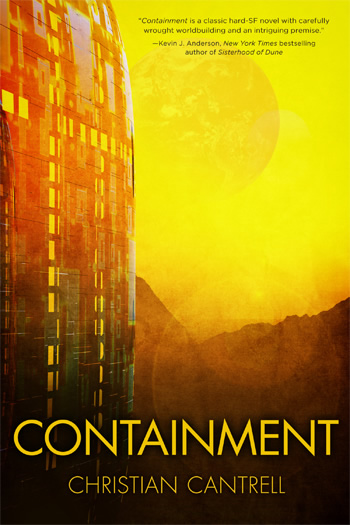 As Earth’s ability to support human life begins to diminish at an alarming rate, the Global Space Agency is formed with a single mandate: protect humanity from extinction by colonizing the solar system as quickly as possible. Venus, being almost the same mass as Earth, is chosen over Mars as humanity’s first permanent steppingstone into the universe.
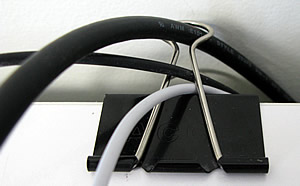 I keep a couple of these big binder clips attached to the back of my desk in order to hold cords and cables that I want to make sure don’t slide back behind my desk when they’re not attached to something. Since I’m frequently switching between laptops — disconnecting then reconnecting multiple cables — this technique has saved me a huge amount of time and frustration. No more grabbing at cables as they slip away behind the desk, then trying to fish them back up.
 I don’t know what this thing is called, so I call it the “banana noose” though I suppose it could just as correctly be called the “banana gallows”. It’s simply a device that suspends bunches of bananas in order to keep them from pressing against the kitchen counter and getting prematurely mushy.
 Living Digitally